
Introduction
The tech world is buzzing in 2025. With AI accelerating at breakneck speed, it’s natural to ask: Will AI replace cloud computing? Cloud services like AWS, Azure, and Google Drive power our work and personal life. They underpin everything from startups to enterprise operations. Yet, as AI—driven by giants like OpenAI, Microsoft, and Nvidia—is baked into infrastructure, some think the cloud might vanish.
But that’s not how the story unfolds. In reality, AI cloud synergy is what’s taking shape. AI needs the cloud to run; the cloud needs AI to stay smart. The future isn’t about replacement—it’s about evolution.
In the Blog:
- What cloud computing truly is
- How AI enhances and depends on the cloud
- Why the cloud stays essential with AI, not replaced by it
- The shared future of cloud, AI, and cybersecurity
- Career paths worth considering in this evolving landscape
We’ll also show how AI isn’t sidelining cybersecurity—it’s making the field more critical than ever. Along the way, you’ll find natural links to trusted insights like why cybersecurity still matters in 2025, 9 reasons AI won’t replace cybersecurity analysts by 2030, and more.
1. What Is Cloud Computing?
Cloud computing means renting computer power and storage—from servers you don’t physically own—over the internet. Think of it like a virtual hard drive in the sky—scalable, flexible, and accessible anywhere.
Key benefits:
- Scalability: Instantly adapt to demand—no wait for hardware.
- Cost‑efficiency: Pay for what you use, minus purchasing and maintenance hassles.
- Global availability: Work from anywhere, on any device, with tools like AWS, Azure, and Google Cloud.
We’re also seeing strong growth in hybrid and multi‑cloud environments. Companies now spread workloads across providers for flexibility, cost savings, and resilience.
Another rising trend: edge computing. By performing tasks closer to users or devices, it reduces latency—critical for IoT and real-time apps (en.wikipedia.org).
Within all this, cloud security plays a big role. Providers offer encryption, IAM, and monitoring—but smart threats and misconfigurations mean security remains a shared responsibility.
2. AI’s Role in the Cloud
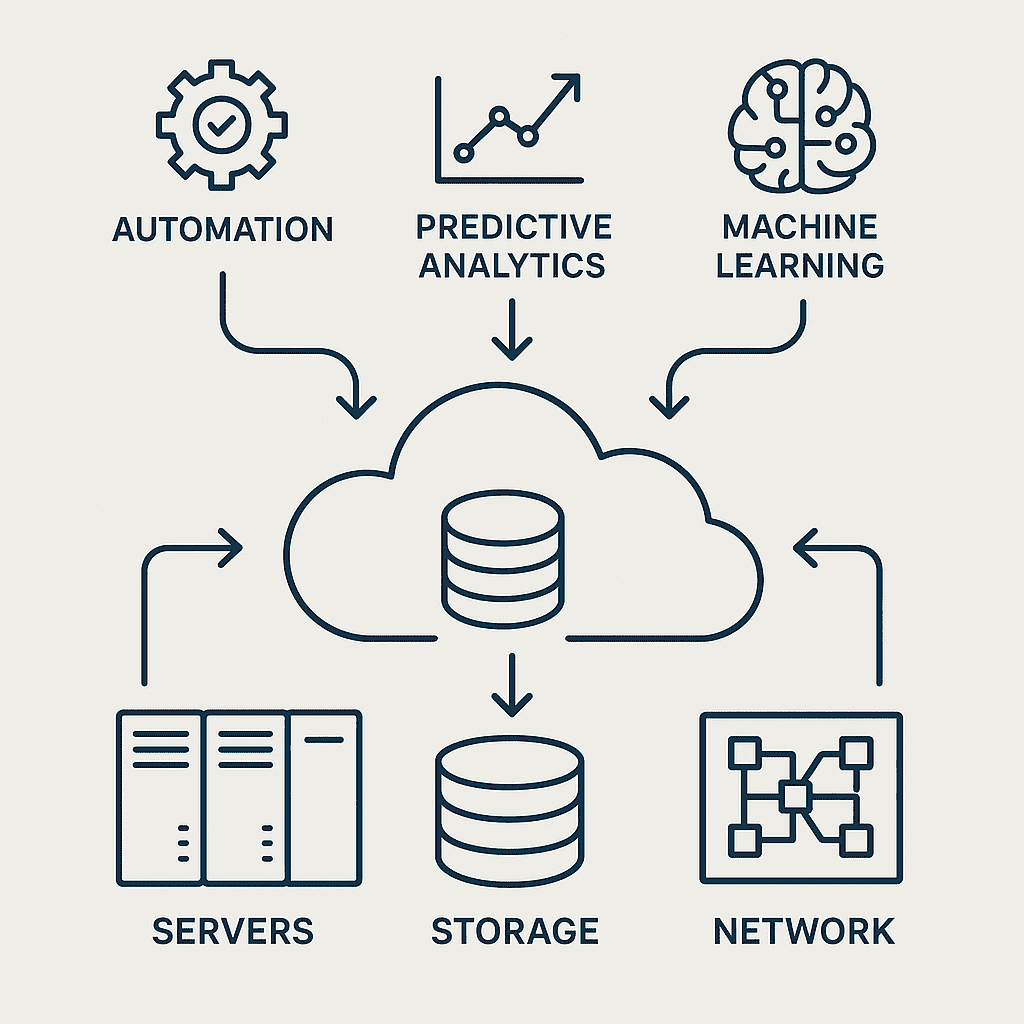
AI is transforming cloud computing from a dumb pipe into a smart, proactive partner:
- Automation of tasks: AI scripts can provision servers, scale storage, and adjust performance instantly.
- Cost optimization: AI analyzes usage patterns to shift workloads during off-peak hours or switch to cheaper resources.
- Performance tuning: Smarter provisioning and troubleshooting with predictive insights.
- Built‑in ML services: Tools like AWS SageMaker and Azure ML Studio allow anyone to build, test, and scale AI models directly in the cloud.
Real-world AI‑cloud synergy:
“While AI is becoming more powerful, many experts believe it’s not replacing core technologies, but enhancing them. A good example is how cybersecurity is evolving. Here’s why cybersecurity still matters in 2025, even as AI becomes more common.”
Cloud and AI are feeding each other:
- AI needs massive cloud infrastructure and GPUs to train.
- Clouds stand to gain from AI but can’t function without it in the modern era.
3. Will AI Replace Cloud Computing?
Let’s bust the myth: no, AI won’t replace cloud computing. Here’s why:
- Infrastructure Reliance
AI runs on the cloud. AI needs data centers with GPUs, storage, networks, and global distribution—all cloud fundamentals. - Scalability vs Intelligence
Cloud excels at scaling compute. AI excels at finding insights in data. One doesn’t substitute the other—they complement. - Hybrid ecosystems
Most systems mix cloud, edge, on‑premise, and even quantum. This hybrid and multi‑cloud trend highlights cloud’s central role . - Continued demand for cloud security
Securing complex, layered environments needs cloud expertise plus cybersecurity know‑how. - Vendor investment
Major cloud players are doubling down:- AWS invests heavily in cloud AI and infrastructure.
- Oracle and OpenAI inked a $30 billion deal to build AI-specific cloud capacity .
- Nvidia’s AI cloud ambitions signal new forms of cloud services.
- Alibaba is pouring $50 billion into AI and cloud in China according to the times (thetimes.co.uk).
- Dell, Microsoft, and even startups are building edge‑AI‑ready data centers.
So: AI enriches the cloud—it doesn’t make it obsolete.
On the flip side, AI without cloud is limited—it needs global infrastructure, data pipelines, and orchestration tools the cloud provides.
“Although AI is changing technology, cloud computing is unlikely to be entirely replaced by it. Instead, these technologies work in tandem to improve one another’s capabilities.”
4. Cloud vs AI vs Cybersecurity
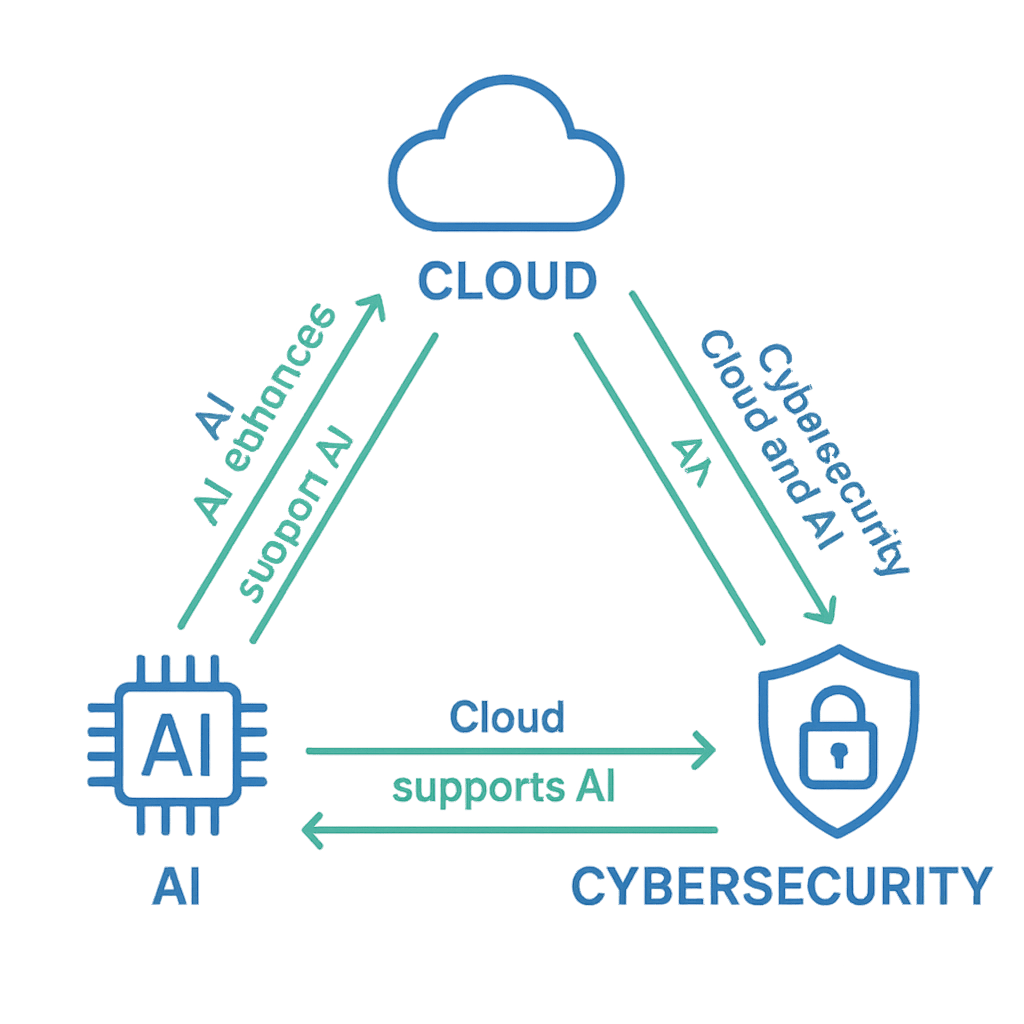
In short:
- Cloud provides scalable infrastructure.
- AI adds intelligence, automation, and adaptability.
- Cybersecurity ensures trust, compliance, and security.
Cybersecurity is advancing with AI—both to defend and respond to smarter threats.
Common trends:
- Zero‑trust architectures, cloud security mesh, and continuous authentication
- AI-powered detection systems using behavioral baselines
- Threat intelligence pipelines that adapt in real time
Cybersecurity isn’t shrinking—it’s expanding. And not just in scale, but sophistication.
“Interestingly, the same discussion is happening in cybersecurity. People wonder if AI will replace cybersecurity jobs. But studies and industry insights show otherwise. In fact, here are 9 surprising reasons AI won’t replace cybersecurity analysts, even by 2030.”
Human expertise remains important, and here’s why:
- Analysts interpret context, pivot analyses, and guide response
- They understand business flow, legal/regulatory contexts, and cultural nuance.
- They do ethical and policy‑based decision‑making that AI can’t replicate.
“AI will automate repetitive tasks, but tier‑1 analysts, threat hunters, and architects will still oversee, adapt, think, communicate, and design.”
5. Careers & Certifications in 2025
If you’re eyeing a tech career, consider roles across cloud, AI, and cybersecurity:
- DevOps / Cloud Engineer: design, build, automate cloud systems.
- Site Reliability Engineer: keep services reliable at scale.
- Cloud Architect / Security Architect: shape and secure multi‑cloud environments.
- AI/ML Engineer: build intelligent models in the cloud.
- SOC Analyst / Threat Hunter: investigate anomalies and secure systems.
AI skills are becoming a baseline:
“Cybersecurity roles will wrap around AI capabilities, not be replaced by them.”
Certifications remain a fast-track to hiring:
“For those considering certification, these 7 must‑have cybersecurity certifications in 2025 can help you launch your career and stay ahead of AI advancements.”
The SecurityWalay guide outlines:
- CompTIA Security+
- Certified Ethical Hacker (CEH)
- CISSP
- CISM
- CCSP
- AWS/Azure Cloud Security
- SOC Analyst Bootcamps
Pair technical certs with cloud skills, and you’re highly marketable.
Also, see: Which cybersecurity field is best in 2025?. It walks through roles like threat intelligence, IoT/OT security, cloud security, and incident response—complete with salary data and demand trends.
6. Challenges
While this future looks bright, there are real risks:
- Misconfiguration & vendor lock‑in: Hybrid architectures reduce single‑vendor risk.
- Edge complexity: Decentralized systems need coherent security policies.
- Data bias in AI: Training on limited datasets leads to blind spots or false alerts.
- Supply chain threats: Attacks on cloud services can disrupt many users.
- New adversarial AI: Deepfakes, AI-generated malware—cloud defenses must adapt fast .
- Reading regulatory shifts: As AI/cloud laws evolve, professionals need to stay informed.
Essential skills now include cloud automation (IaC), AI ethics, zero‑trust design, and compliance frameworks.
7. The Year After 2024
- AI-first cloud infrastructure: OpenAI‑Oracle and Nvidia’s cloud initiatives .
- Edge-to-cloud continuum: From IoT to real-time AI insights .
- Zero-trust adoption: Cloud-native architectures with continuous validation.
- Post-quantum & secure multiparty computing: For data in transit and at rest.
- Ethical AI audits: Governance frameworks that blend legal, ethical, and technical safeguards.
In summary:
- AI enhances cloud—it doesn’t replace it.
- The cloud is the backbone for AI and edge solutions.
- Cybersecurity remains essential and human-centric.
- Tech careers thrive at this intersection of cloud + AI + sec.
“Some worry AI will make cybersecurity and cloud roles irrelevant, but that’s far from true. Here’s why cybersecurity isn’t going anywhere soon.”
Conclusion
AI and cloud computing are evolving together—not clashing. AI accelerates cloud efficiency, while cloud provides the scale and infrastructure AI needs. Add cybersecurity to the mix, and you have a future where tech professionals are more in demand—not less.
If you’re planning a tech career:
- Combine cloud and AI skills
- Pursue certifications in cloud security and incident response
- Stay agile and keep human oversight central
- Be ready for the ethical, regulatory, and technical layers shaping tomorrow
Whether you’re a developer, cloud architect, AI engineer, or security analyst, your role matters. This is the tech-big-three era—cloud + AI + security—and it’s thriving, not fading.